

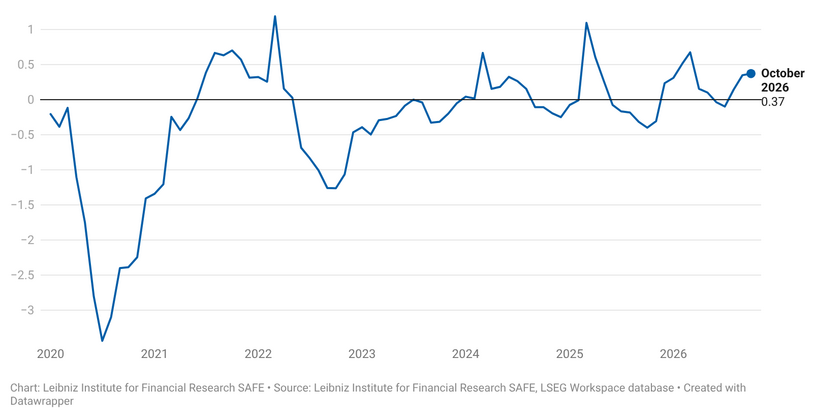
The SAFE Management Sentiment Index rose from −0.10 points in July to +0.37 points in October. Calls held in the third quarter of 2026 largely discussed second-quarter and first-half results. The rise in sentiment concealed a sharply uneven picture across sectors.
Since March, managers’ statements have increasingly shifted from assessing the initial shock of the Iran war to describing its consequences and firms’ responses. Several firms reported stabilizing conditions, even though higher costs and supply disruptions continued to weigh on business. Against this backdrop, and amid Europe’s hot and dry summer, managers highlighted how hedging and adjustments to logistics helped protect operations.
Highest sentiment in consumer cyclicals, technology and industrials sectors
Of all sectors, the consumer cyclicals sector showed the most positive sentiment. One manager reported strong demand: “The sell-out is stronger than sell-in. I have never seen numbers like this before.” Another highlighted the broad-based growth: “Organic sales went up around 9%, driven by all […] regions and all our business lines.” Inflation nevertheless affected firms within the sector differently: Some reported “inflationary pressures,” while others indicated that selling prices were holding up well enough to offset inflation.
However, automotive firms, which are also part of the consumer cyclicals sector, sounded much more cautious, highlighting pressure from China and an industry crisis: “Chinese competitors not only export their vehicles to Europe, but they also export competitive pressure.” Another executive said that “the environment has never been as heavy as we are faced today.”
In the technology sector, strong demand for AI and cloud services supported managers’ optimism. While US firms have led the development of advanced AI models, their growing use in everyday business creates opportunities for German technology firms to help customers adopt them. Demand for these AI implementation services, alongside improving semiconductor demand, contributed to the positive sentiment in the technology sector. One manager reported: “Following a particularly strong second quarter, we closed H1 2026 with solid double-digit revenue growth, continued strong profitability, and positive order momentum.” Strong company performance nevertheless coexisted with difficult business conditions. As another manager put it, “the framework conditions have not improved, they remain challenging.”
In the industrials sector, managers reported “strong demand signals across all of our key regions.” Defense-related businesses pointed to a multi-year investment cycle with large spending commitments. One executive explained that these commitments “give us a long-term demand visibility that supports the capacity investments we are already making.”
Sentiment of basic materials sector improved notably
Basic materials, financials, real estate, and healthcare recorded a lower sentiment than the other sectors. Notably, although still among these sectors, basic materials no longer recorded the most pessimistic sentiment for the first time since the second quarter of 2025.
Improving financial performance contributed to the sector’s improvement in sentiment, although managers remained cautious about underlying demand. One executive stressed, “This was not the result of a broad market recovery. It was a result of actions within our control.” Stronger results were reportedly linked to cost savings, price increases to pass on higher input costs to protect margins, and their ability to supply customers when competitors could not. Another manager attributed around one-third of growth to expanding the business, another third to customers buying ahead, and the remainder to customers switching suppliers “because other suppliers were short on raw materials and not capable to deliver.” Better results therefore reflected both company-specific strengths and temporary market conditions, leaving the durability of the recovery uncertain.
From assessing the shock of the Iran war to managing its consequences
As discussed in our first-quarter blog, the war in Iran initially left managers surprised and unsure about its economic effects. Our second-quarter blog showed that three months later, managers had already highlighted consequences for costs, consumption, and investment, as well as firms’ preparedness. The calls in the third quarter offered more concrete accounts of effects and firms’ responses. Some managers reported stabilization: A real estate executive described that “after a temporary demand shock at the start of the conflict in the Middle East […] we saw a stabilization in investor sentiment and a steady return to more normalized sales ratios,” while a financial-sector manager noted that “risk appetite gradually returned.”
These signs of stabilization coexisted with weak demand and continuing cost pressures. Managers discussed higher costs for energy, raw materials, and logistics, as well as tariff burdens and, for some firms, tariff refunds. The timing of these effects varied. Speaking in July, a healthcare executive expected inflation to affect profits more strongly in the third quarter. A manager in basic materials warned: “We do not expect the supply situation to normalize before mid-2027.” More stable conditions therefore did not imply that the disruption had passed.
Hedging cushions price increases but protection has limits
Firms across different sectors described how financial hedging helped absorb higher energy prices. By securing prices in advance or by using financial contracts, firms can limit their exposure to price movements for a defined period. One basic materials executive attributed energy costs remaining “broadly on par with the prior year level” to energy management and hedging. A healthcare manager similarly explained: “we don't feel the full impact of the energy crisis due to the strong hedging position.”
However, existing protection may weaken as contracts expire. The same healthcare executive reported being “less than 50% hedged” for the following year. An industrials manager also cautioned that “not all hedges are equally effective under all market conditions,” referring to differences between different oil products. Financial hedging can cushion price increases, but it cannot guarantee physical supplies. This distinction matters amid concerns about oil shipments through the Strait of Hormuz and the Bab al-Mandab Strait, and gas reserves ahead of winter. Firms’ preparations have helped them manage higher costs, but prolonged supply disruptions could test the limits of that protection.
Firms adapt their operations to the hot and dry summer
While financial hedging helped some firms contain rising costs, preparations to keep operations on the ground running proved valuable during the hot, dry summer. The earnings calls show that the weather affected firms differently. In consumer cyclicals, one manager reported strong sales during the heatwave, “particularly in air conditioning products.” Managers from insurance companies discussed wildfire losses. One expected catastrophe losses to remain “within our quarterly cat load,” although it was still too early to assess the full impact. “Cat load” refers to the amount the insurer had budgeted for catastrophe claims that quarter.
Low water levels in the Rhine provided a clear example of how preparations helped limit disruption. Managers in basic materials described a response shaped by lessons from the severe drought in 2018, when low Rhine water levels disrupted inland shipping and industrial supply chains. One reported that the company’s logistics were “far more flexible than we were in 2018.” Alternative supply routes were already available, and transport capacity was secured early. Another acknowledged higher freight costs but concluded that “overall, it is manageable.” In the energy sector, one manager explained that deliveries could continue “through our established rail and truck deliveries.”
The limited disruption reported by several managers was somewhat surprising given media reports warning of limited transport alternatives and possible production cuts. One possible explanation lies in the firms covered by the SAFE Manager Sentiment Index. These are companies listed on German stock exchanges, many of which have substantial resources to prepare for disruptions. Their experience may therefore differ from that of smaller businesses with less capacity to invest in alternative logistics.
Looking ahead
Managers were more optimistic, partly because their preparations helped them cope with difficult conditions. The next quarter will show how persistent this improvement in sentiment is. Some firms expect further cost increases, while supply shortages may persist in 2027. As existing hedges expire, firms could become more exposed to higher energy prices. A sustained improvement will therefore depend on both stronger demand and firms’ ability to manage continuing pressures. The outlook will also depend on the developments in the Middle East, particularly whether normal shipping through the Strait of Hormuz can resume.
Alexander Hillert is Co-Director of the SAFE Department “Financial Intermediation” and Professor for Finance and Data Science.
Denise Rößler is Financial Economist at the SAFE Policy Center.
Blog entries represent the authors’ personal opinion and do not necessarily reflect the views of the Leibniz Institute for Financial Research SAFE or its staff.

