

This blog post examines the key topics discussed by managers of publicly listed firms in Germany during earnings conference calls held in the second quarter of 2026. During this period, the SAFE Manager Sentiment Index continued to weaken, declining continuously from +0.15 points in April to -0.10 points in July. Nevertheless, firms generally reported strong numbers for the first quarter, confirmed their financial guidance conditional on the war in the Middle East ending soon, and highlighted resilient business performance despite a more volatile macroeconomic and geopolitical environment.
While managers emphasized resilience and preparedness in response to the uncertainty created by the war, two additional themes stood out across calls: Firms increasingly reported measurable productivity gains from artificial intelligence, while adverse weather events were discussed across a broad range of industries as a material operational risk.
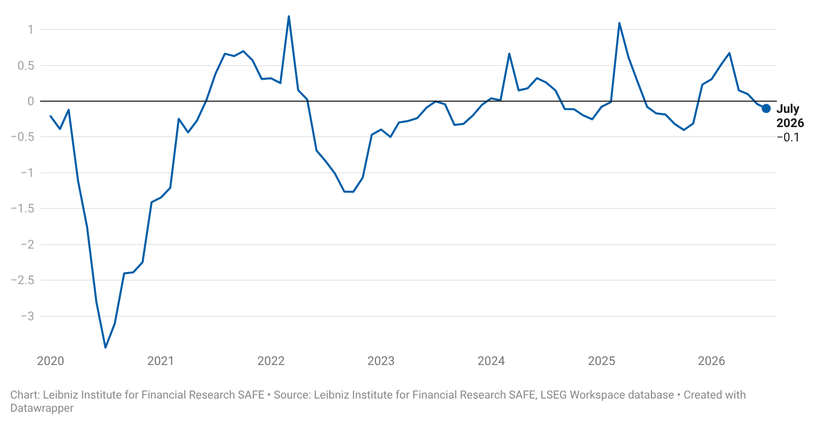
Sectoral differences in sentiment
As manager sentiment weakened during the second quarter, differences across industries became less pronounced than in the first quarter, suggesting that growing macroeconomic and geopolitical uncertainty affected firms broadly in the same way. The sectors of consumer non-cyclicals, technology, and energy exhibited the most positive sentiment. Managers in the technology industry highlighted strong and stable demand alongside growing productivity gains from digitalization and artificial intelligence, while the improvement in the energy sector likely reflected the more favorable earnings environment associated with higher oil and energy prices.
By contrast, sentiment weakened more noticeably in the consumer cyclicals, basic materials, and real estate sectors, where managers pointed to subdued consumer demand, higher input costs, and uncertainty surrounding the economic outlook and interest rates. Executives in the financial sector grew more cautious, highlighting potential negative implications from the war for markets and investment activity.
Middle East war: Prepared for disruptions but uncertainty still makes it hard to plan
Throughout the second quarter, the war in the Middle East emerged as one of the most frequently discussed risks in earnings calls. Since April, the war has continued to evolve rapidly. The discussion below summarizes managers’ sentiment from April to June and therefore reflects the firms' views at that time, not their assessment of the current geopolitical situation.
Managers repeatedly referred to a volatile macroeconomic and geopolitical environment, but most also emphasized that their businesses had remained resilient. Many firms confirmed their financial guidance, suggesting that the war had not yet materially altered underlying business conditions. Instead, executives consistently highlighted that the main challenge was their inability to predict how the situation would evolve.
The war could increase inflationary pressure and lead to higher interest rates
Reflecting this uncertainty, a manager from the basic materials sector remarked that "it is hard to say right now as things change quickly," while one executive from the finance industry stressed that "the impact... remains uncertain. It is not yet possible to come up with reliable estimates." Similarly, managers from the consumer cyclicals and real estate sectors warned that "we cannot rule out that the outlook of the year will worsen" and that "it remains to be seen how the interest rates and the real estate markets will move."
These concerns reflect the real estate sector's sensitivity to financing conditions, which can be affected by heightened macroeconomic and geopolitical uncertainty. Due to the higher prices resulting from the war, central banks may be forced to raise interest rates to keep inflation under control. Higher rates will result in higher costs for mortgages, lowering demand for real estate. In its meeting on 11 June, the European Central Bank raised rates by 25 basis points.
Limited current impact and growing future risks
Reflecting these concerns, firms distinguished clearly between current impacts and future risks. Most companies described their direct exposure to the region as low, with an energy company stating that "the financial impact of the Middle East war has been very limited," while a healthcare company explained that the effects were "currently absorbed within our range of inflation assumptions."
At the same time, executives warned that a prolonged war could gradually feed through higher logistics, raw material and energy costs into inflation, supply chains, and demand. A manager from the real estate sector noted that "the longer the war will be, the likelier it is to see inflation pick up," while an industrials company warned that "if the situation prolongs for long, we might start to see disruptions in supply."
Consumer and investment caution amid persistent uncertainty
Several firms pointed to weaker consumer demand and delayed investment decisions as potential second-round effects. A manager from the consumer cyclicals sector observed that the war had a "dampening effect on consumption across Europe," while an executive from the basic materials sector warned of a potential "demand destruction effect." Similarly, a manager from the industrials sector noted that geopolitical uncertainty was already "weighing on customer investment behavior."
Rather than attempting to forecast geopolitical developments, managers focused on preparedness. An executive from the consumer cyclicals sector commented "we have to prepare for these kinds of disruptions and make [the company] more robust." Similarly, firms from the industrials sector emphasized the lessons learned from recent crises. One executive noted that "we had learned many lessons in 2022," while another explained that they were "working on protecting [the company] in terms of supply chain disruptions." Others highlighted close monitoring of supply chains, safety stocks for critical raw materials, and efficiency measures to mitigate the financial impact of higher input costs.
Overall, the earnings calls suggest that companies increasingly regard geopolitical uncertainty as a permanent feature of the business environment, emphasizing resilience, cost mitigation measures and contingency planning.
From AI experimentation to measurable productivity
Artificial intelligence was one of the most consistently positive topics across earnings calls in the second quarter, with companies increasingly describing AI as a driver of productivity, automation, and operational efficiency. Across industries, executives emphasized that AI is becoming embedded in day-to-day operations and decision-making, with one company highlighting its application "across all corporate functions" and expecting "tangible benefits in future."
In the financial sector, discussions focused on AI's dual role in enhancing customer-facing digital services while improving operational excellence, risk management, and efficiency with one executive describing it as "a core driver of efficiency and a creator of new revenue opportunities." Efficiency gains were also reported by energy sector executives who highlighted the “material” impact of AI on coding, enabling companies to achieve more with their investment budget. Taken together, the earnings calls suggest that AI is evolving from experimenting on how to include AI in firms’ business operations to incorporating it as an established tool for improving productivity and operational efficiency across industries.
Severe Weather: A growing challenge for business operations
Across sectors, weather-related disruptions emerged as a recurring topic in the calls in the second quarter, with companies describing the operational consequences of adverse weather conditions.
Companies in the consumer cyclicals sector highlighted severe winter storms and hurricanes in Europe and the United States that disrupted logistics, reduced demand, and weighed on quarterly earnings. While one executive referred to a "once in 75 years" winter storm, another noted that results "would have been even better" without the impact of a hurricane. Similar effects were reported in industrials, healthcare, and financials, where companies linked adverse weather to delayed projects, lower activity levels, and weather-related insurance claims following severe winter conditions.
Taken together, the calls highlight that weather remains an important external factor influencing business performance across weather-sensitive industries, affecting both day-to-day operations and short-term financial results.
Looking ahead
Overall, the second-quarter earnings calls suggest that listed companies in Germany remained operationally resilient despite a more uncertain environment. While managers generally confirmed their financial guidance, discussions focused on geopolitical risks, technological transformation, and weather-related disruptions. Since these earnings calls took place, the temporary ceasefire in the Middle East has broken down, with renewed military escalation and attacks on shipping in the Strait of Hormuz reinforcing the uncertainty that managers repeatedly emphasized. Until there is a more comprehensive and persistent solution for the war in the Middle East, it will continue to be a main topic on managers' minds.
With respect to the severe weather, we look forward to understanding the extent of managers’ discussions of June’s and July’s heat waves in Western Europe in the upcoming calls. The high temperatures might have not only impacted consumer demand, but also firms' employees and their productivity.
Alexander Hillert is Co-Director of the SAFE Department “Financial Intermediation” and Professor for Finance and Data Science.
Denise Rößler is Financial Economist at the SAFE Policy Center.
Jette Witt is a Student Assistant in the department Financial Intermediation at SAFE.
Blog entries represent the authors’ personal opinion and do not necessarily reflect the views of the Leibniz Institute for Financial Research SAFE or its staff.

