
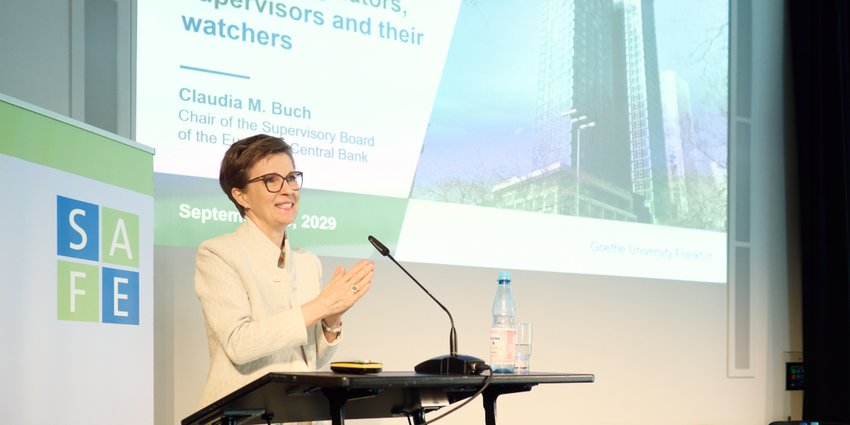
Europe needs strong financial markets to finance investment and growth while safeguarding financial stability. Banks and markets are not the only institutions that should be held accountable. Financial regulation and supervision also need to demonstrate their effectiveness and be subject to systematic evaluation.
At the first Watching European Financial Market Regulation and Supervision Conference on 15 September 2026, researchers and representatives from the financial sector, regulatory authorities and supervisors discussed how Europe’s financial architecture should respond to geopolitical uncertainty, technological change and new competitive pressures.
Overcoming fragmentation
In her keynote, Claudia Buch, Chair of the Supervisory Board of the European Central Bank (ECB), stressed the importance of accountability and public scrutiny. “This is why a broad community of watchers matters: policymakers, banks, researchers, analysts, journalists, civil society and citizens. Each group brings valuable input,” she said. Buch also cautioned against sacrificing long-term resilience for short-term gains, warning that there is “also a non-negligible risk that the balance might be tilted towards the perceived short-term benefits of weaker standards at the expense of higher long-term risks.”
The first panel examined the persistent fragmentation of European banking markets, which “we should not be complacent with”, Elena Carletti, Professor of Finance at Bocconi University said. To foster growth in Europe, Carina Kozole, Chief Risk Officer, ING Netherlands, stressed the importance of integration rather than deregulation. It was highlighted that cross-border banking activity remains constrained by incomplete common safeguards and crisis-management frameworks.
In the discussion on the interplay between international cooperation and financial stability, Gaston Gelos, Deputy Head of the Monetary and Economic Department at the Bank for International Settlements, emphasized that financial stability is a global public good that needs coordinated action across borders. Amit Seru, Professor of Finance and Economics at Stanford University, meanwhile warned against a regulatory race to the bottom. He cautioned that standards should not be eased in the name of competitiveness.
Patrick Amis, Director General Microprudential Supervision at the ECB, challenged the idea that growth and regulation should be seen as competing objectives. Resilience and sustainable growth, he argued, can reinforce each other. The discussion also addressed how regulatory requirements could be made less burdensome without compromising their objectives. Karen Braun-Munzinger, Board Member of the Single Resolution Board, pointed to scope to “reduce burden without lowering standards.”
Europe´s digital future
Regarding Europe’s digital future, one question stood out: How can Europe keep pace with technological change without losing control over its financial infrastructure? The discussion around tokenization, stablecoins and the digital euro highlighted the need for innovation while preserving the role of European institutions and central bank money. As Piero Cipollone, Member of the Executive Board of the ECB, put it: “The only way to compete with America is to play in their field: be innovative.”
For Tobias Adrian, former Director of the IMF Monetary and Capital Markets Department, innovation must go hand in hand with the continued role of central bank money. As tokenization and blockchain technology reshape financial intermediation, central banks must remain able to provide liquidity and act as lenders of last resort. Tokenized reserves could become one way of supporting liquidity provision in a digitalized financial system while maintaining trust, stability and the singleness of money.
The question of whether Europe is creating the right environment for such innovation remained more contentious. Martin Bruncko, Founder & CEO of Schuman Financial, argued that “we do not trust European entrepreneurs enough”, criticizing policymakers and the banking sector for blocking rather than enabling innovation.
The program provides a complete overview of the topics and participants.

