

The SAFE Manager Sentiment Index rose from -0.10 points in July to +0.14 points in August, returning to positive territory. The decisive factor was the more upbeat language used in the 35 earnings calls held in July, in which listed companies in Germany presented their second-quarter results.
Managers frequently reported stronger sales, earnings, demand, and orders. The expression “strong growth" appeared 42 times and “strong performance" 30 times. Other frequent phrases included “delivered strong” (22 mentions), "strong demand” (21), and “strong momentum” (20). At the same time, the conflict in the Middle East remained the most important negative topic, affecting costs, supply chains, consumer sentiment, and customer decisions.
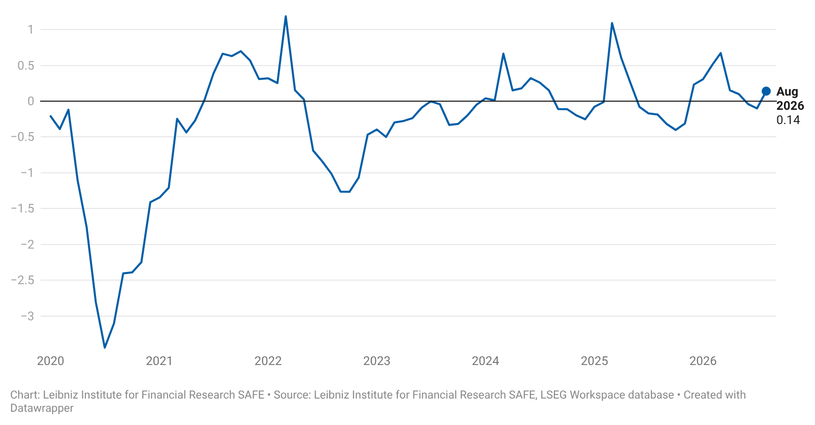
“The increase in the SAFE Index shows that many companies performed better in the second quarter than the difficult environment would have suggested” says Florian Heider, Scientific Director of the Leibniz Institute for Financial Research SAFE. “The conflict in the Middle East remains a serious burden, but strong company results currently outweigh the negative effects. Managers report solid demand, rising revenues and profits and, in some cases, higher full-year targets.
Strong results across several sectors
The positive tone was broad-based. One manager said, “In Q2, we delivered a strong quarter with strong momentum in our business.” Another reported “a strong first half in 2026, supported, particularly, by a strong second quarter: double-digit revenue growth and profitability above our guidance.” A third described “a very strong result in the first half of 2026 with significant increases in revenues, profits, and orders.” Other calls highlighted improved cash generation, strong order momentum, and upgraded outlooks.
“The August increase is primarily a result of managers talking more positively about concrete second-quarter outcomes such as revenue, profits, orders, and cash flow,” says Alexander Hillert, Professor of Finance and Data Science at SAFE. “These results reduce immediate concerns about profitability. However, a good quarter does not remove risks for the second half of the year.”
Middle East conflict keeps uncertainty high
The conflict affected companies through several channels. Managers referred to volatility in energy, raw material, and logistics costs, supply disruptions, weaker demand in some consumer markets, and slower customer decisions. One manager said the ongoing conflict was “continuing to weigh on customer sentiment and decision-making.” Another stated: “The ongoing conflict in the Middle East continues to create volatility.”
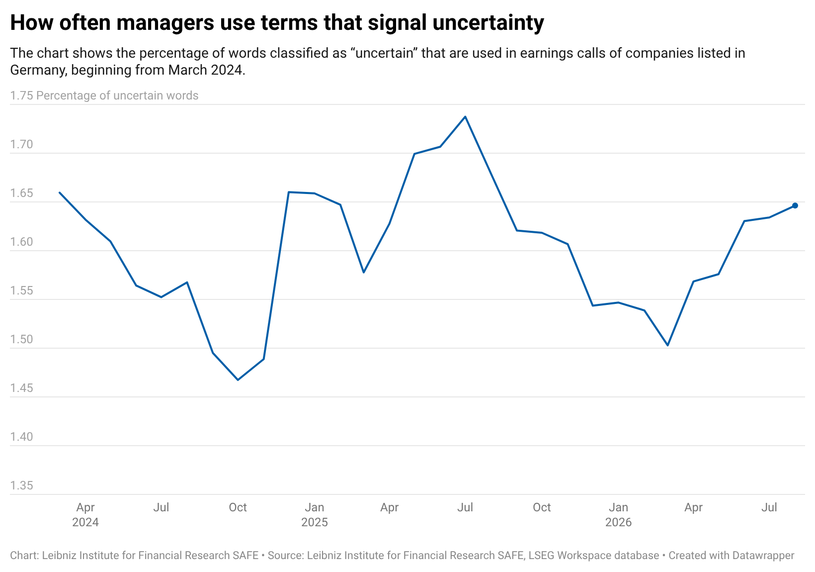
The share of uncertainty words used in earnings calls rose slightly from 1.63 percent in July to 1.65 percent in August. One manager said, “The conflict in the Middle East continues to add uncertainty to an already highly uncertain global economic and automotive market environment.” Another summarized: “Visibility remains limited, and the supply situation is still very dynamic as the conflict is taking unpredictable turns.”
“Higher sentiment and higher uncertainty are not contradictory,” Hillert says. “Managers can report strong results for the quarter that has just ended while remaining unsure about demand, costs, and investment conditions in the months ahead. The August data therefore show a clear divide: current company performance has improved, but the outlook remains difficult to assess.”
The SAFE Manager Sentiment Index
The SAFE Manager Sentiment Index measures the optimism or pessimism expressed by executives of listed companies in Germany monthly. Developed by Alexander Hillert and his team at the Leibniz Institute for Financial Research SAFE, the Index is based on automated text analysis that evaluates positive and negative statements in financial reports and earnings calls. The Index is based on a three-month rolling window of data.
Since May 2025, the team has systematically measured uncertainty expressed in financial communication, using the Loughran and McDonald Dictionary of Uncertainty Words. This analysis captures uncertainty based on narratives – how often corporate leaders express ambiguity, risk, or doubt. It enables pinning down what top managers are uncertain about.
The future scheduled release dates are:
- Thursday, 10 September 2026
- Thursday, 8 October 2026
- Tuesday, 10 November 2026
- Thursday, 10 December 2026

