

In October, the SAFE Manager Sentiment Index is almost unchanged, edging up from +0.35 points in September to +0.37 points. The share of words reflecting uncertainty used in earnings calls also barely moves, from 1.51 percent to 1.52 percent.
September tends to be a quiet month for corporate reporting, with comparatively few earnings calls. As a result, only a limited amount of new information entered the Index's three-month window. One manager summed up the broader picture: “When we last spoke, we discussed an environment characterized by uncertainty, geopolitical tensions, weak economic growth, and persistently high insolvencies. And this environment has not fundamentally changed.”
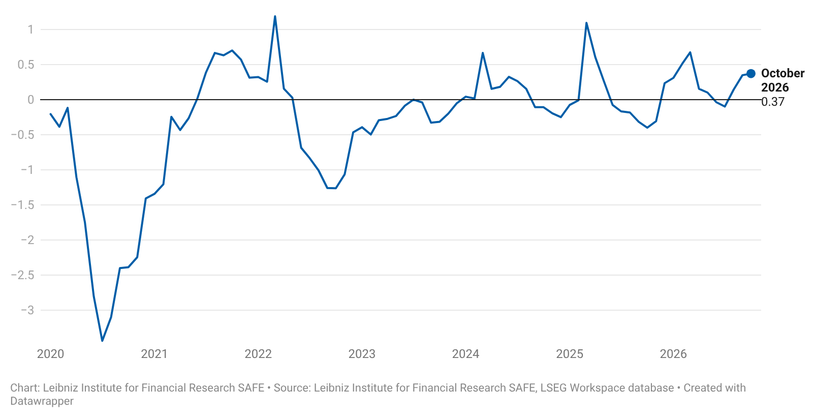
“The Index in October confirms that managers remain mildly positive overall, but the signals are mixed,” says Florian Heider, Scientific Director of the Leibniz Institute for Financial Research SAFE. “Strong company results coexist with weak markets and cautious customers.”
Strong companies coexist with difficult markets
The earnings calls show large differences across firms. Over the current three-month window, “strong growth” was mentioned 114 times and “strong performance” 97 times. At the same time, “challenging market” and “negative impact” appeared 35 times each, while “sales declined” was mentioned 26 times.
One manager reported that “the second quarter was again marked by strong demand around the world” and that revenue reached “a new record for the second quarter.” Another described current trading as “relatively soft” and “quite challenging.” A third summarized the contrast within one company: “The environment remains challenging, but our business is getting stronger.”
“The Index at +0.37 points does not mean that all companies are optimistic,” says Alexander Hillert, Professor of Finance and Data Science at SAFE. “It reflects the balance of very different experiences. Strong demand and order books in some sectors are offset by weak consumer demand, postponed investment decisions, and declining sales elsewhere.”
German economy shows resilience, but recovery remains fragile
Managers also differ in their assessment of the German economy. One called 2026 “a highly challenging year for the German economy” and pointed to GDP growth of only 0.2 percent in the second quarter. Another said that the German economy, “despite all headwinds, shows resilience” and raised its full-year growth expectation from 0.6 percent to 1 percent. Other executives continue to expect subdued business sentiment and strained conditions among corporate customers.
“The comments suggest that managers expect the economy to recover gradually and unevenly,” Hillert says. “Their statements point to improving business activity and order intake. However, investment remains weak, while geopolitical risks continue to weigh on many firms and hinder a broad-based upswing.”
The next update should provide a clearer signal as the third-quarter earnings season begins in October. It will bring many more earnings calls and fresh information on firms' performance in the second half of the year, being an important input for the SAFE Index’s November update.
The SAFE Manager Sentiment Index
The SAFE Manager Sentiment Index measures the optimism or pessimism expressed by executives of listed companies in Germany monthly. Developed by Alexander Hillert and his team at the Leibniz Institute for Financial Research SAFE, the Index is based on automated text analysis that evaluates positive and negative statements in financial reports and earnings calls. The Index is based on a three-month rolling window of data.
Since May 2025, the team has systematically measured uncertainty expressed in financial communication, using the Loughran and McDonald Dictionary of Uncertainty Words. This analysis captures uncertainty based on narratives – how often corporate leaders express ambiguity, risk, or doubt. It enables pinning down what top managers are uncertain about.
The future scheduled release dates are:
• Tuesday, 10 November 2026
• Thursday, 10 December 2026

