

The SAFE Manager Sentiment Index rose from +0.14 points in August to +0.35 points in September. The increase was driven by a more optimistic tone in the 93 earnings calls held in August.
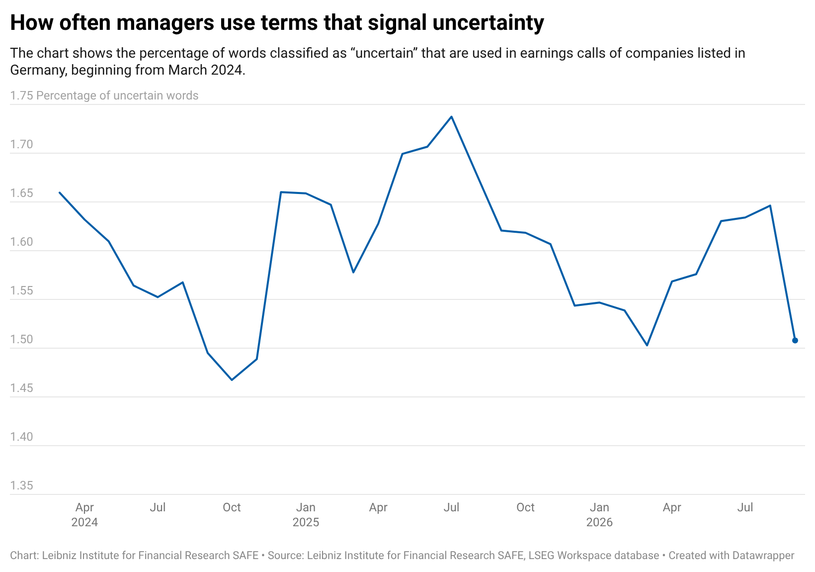
Managers frequently reported strong second-quarter and first-half results. For example, the term “strong growth” appeared 69 times and “strong performance” 65 times in their presentations. The positive language in the August earnings calls was broad-based across the listed companies in Germany. At the same time, the conflict in the Middle East and related uncertainty were discussed much less often than earlier in the summer. The share of uncertainty words fell from 1.65 percent in August to 1.51 percent in September.
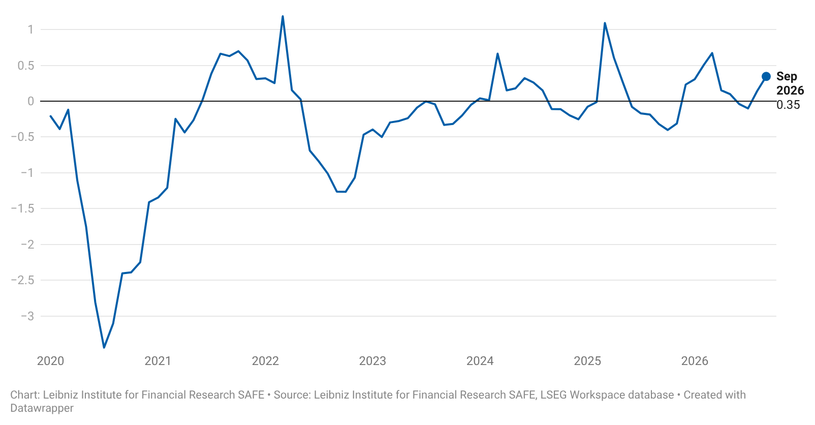
“The September increase of the SAFE Manager Sentiment Index reflects a favorable combination: many companies are reporting good results, while geopolitical concerns are taking up less space in managers’ communication,” says Florian Heider, Scientific Director of the Leibniz Institute for Financial Research SAFE. “This allows positive company fundamentals to shape the overall tone more strongly.”
Low Rhine levels are closely watched, but companies are prepared
For some companies a more immediate risk came into focus: the hot and dry summer. Analysts repeatedly asked about low water levels in the Rhine and possible effects on production and transport. Managers generally reported limited effects so far and emphasized that companies had adapted their logistics after earlier periods of low water.
One manager said lower Rhine levels could have a “tiny impact” through higher freight costs, but that the situation was “manageable” and the company was “well prepared.” Another explained that investments following the low-water episode of 2018 had made the company “far more flexible,” including through alternative transport routes. Several firms reported reserving rail and road capacity or increasing inventories, and some explicitly stated that production had not been affected.
“The Rhine discussion shows how companies have learned from previous disruptions,” says Alexander Hillert, Professor of Finance and Data Science at SAFE. “Low water levels can still raise transport costs, but investments in alternative logistics routes and contingency plans appear to be limiting the economic impact so far.”
Fewer geopolitical concerns
While the effects of low water levels in the Rhine are concentrated among a subset of industrial companies, geopolitical tensions remain a widespread concern for managers. However, mentions of the Middle East conflict declined sharply compared to the previous period. Mentions of “conflict [in the] Middle East” fell by 66, “Middle East conflict” by 54, and “energy crisis” by 23. Terms linked to uncertainty, such as “market volatility” and “difficult to predict,” also became less frequent.
“The data suggest that the strong second-quarter results are no longer being overshadowed to the same extent by geopolitical concerns,” says Alexander Hillert. “The decline in uncertainty does not mean that these risks have disappeared, but managers currently appear to perceive them as more manageable.”
The SAFE Manager Sentiment Index
The SAFE Manager Sentiment Index measures the optimism or pessimism expressed by executives of listed companies in Germany monthly. Developed by Alexander Hillert and his team at the Leibniz Institute for Financial Research SAFE, the Index is based on automated text analysis that evaluates positive and negative statements in financial reports and earnings calls. The Index is based on a three-month rolling window of data.
Since May 2025, the team has systematically measured uncertainty expressed in financial communication, using the Loughran and McDonald Dictionary of Uncertainty Words. This analysis captures uncertainty based on narratives – how often corporate leaders express ambiguity, risk, or doubt. It enables pinning down what top managers are uncertain about.
The future scheduled release dates are:
- Thursday, 8 October 2026
- Tuesday, 10 November 2026
- Thursday, 10 December 2026

