
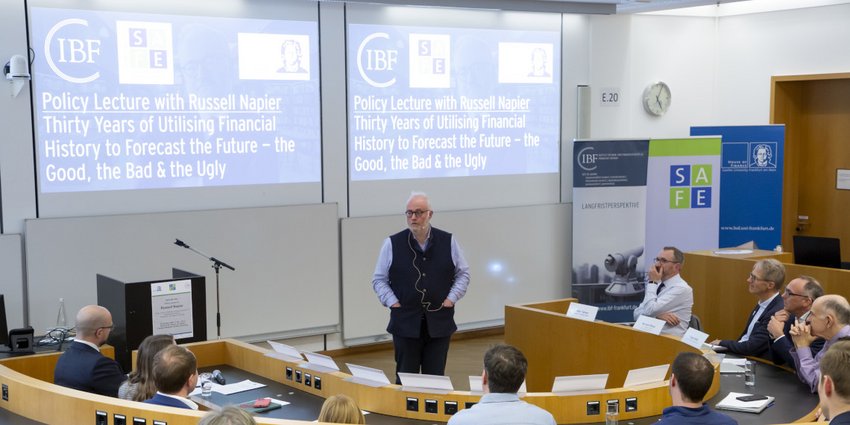
Titled “Insight from Hindsight: Useful Financial History,” the conference featuring this year’s endowed Visiting Professor of Financial History, John Turner of Queen’s University Belfast, took place on 22 October 2026. The event was jointly organized by the House of Finance, the Institute for Banking and Financial History, and the Leibniz Institute for Financial Research SAFE at Goethe University.
The presentations highlighted the exciting opportunities that financial history research offers for addressing macro- and microeconomic issues. A key factor in this is the enourmous volume of historical data, which can increasingly be analyzed using artificial intelligence and requires expertise in financial history to interpret.
Banking regulation, inflation and international capital flows
The conference’s academic presentations demonstrated the potential applications of historical data and methods: Richard Grossman of Wesleyan University examined the impact of regulation on banking stability for the period 1865-1935 using a comprehensive dataset on the historical coexistence of differently regulated US banks at the state level. Jason Lennard of the London School of Economics and Will Quinn of Queen’s University Belfast presented new methodological approaches and datasets that promise more precise insights into historical inflation expectations than previous approaches.
Kirsten Wandschneider of Goethe University Frankfurt presented research on the relationship between the degree of financial openness and economic growth. The study is based on a new dataset on the evolution of capital flows and bank balance sheets during the interwar period.
Saving Behavior and Personal Investment Decisions
Sibylle Lehmann-Hasemeyer of the University of Hohenheim examined how people save during times of uncertainty by analyzing a comprehensive sample of historical savings books from 1929 to 1945. Elissa Iorgulesco of the University of Münster examined the investment decisions of private investors over a similar time period by analyzing the composition of historical securities portfolios.
Carsten Burhop of the University of Bonn presented new research on the economic consequences of the introduction of a state pension insurance system in the Kingdom of Saxony in the 1890s. The results showed a crowding-out effect on private pension provision through savings. Chris Colvin, Queen’s University Belfast, examined the resilience of various frameworks regarding the drivers of economic growth and modernization – including the role of institutions and banks, as well as the economic effects of political integration – based on Ireland’s development in the 19th century.
Insights from Financial History for Practical Application
In his closing keynote address, Russell Napier, financial strategist and founder of the “Library of Mistakes”, emphasized that investors should place greater emphasis on the insights gained from financial historical data and research.
The lively discussion among researchers from various disciplines and practitioners highlighted the interdisciplinary and transdisciplinary potential of financial history research. The Endowed Visiting Professorship in Financial History, sponsored by Bankhaus Metzler and the Friedrich Flick Förderungsstiftung, provides a productive setting for this every year.

